
Cable Zercher Squats
The Zercher Squat is a great exercise...and one that you'll almost NEVER see anybody doing.
It works the legs AND the core very strongly, because of how you hold the weight. It originated as a way to do squats before power racks were widely available.
Instead of supporting the weight on your shoulders, you instead cradle the bar in the crooks of your elbows. This position puts tremendous tension on the supporting muscles of the midsection.
Two of the reasons you'll almost never see this exercise being done is that first, it is extremely tough on the core area to perform. Most people immediately decide it's too hard and don't ever do it again.
Second, it's not very comfortable on the arms. This can be mitigated with a barbell pad or a towel wrapped around the bar.
So normally, you would perform this exercise with a barbell...either from the floor, with the bar starting in the rack or on a bench. I've also done this exercise with a dumbbell (starting from the floor or a bench).
THIS version of the exercise is basically the same as a barbell version only you'll be using the low-pulley cable stack instead of a barbell.
This has a few differences from the barbell Zercher Squat exercise...
1. You don't need a rack to do it and you don't have to start with the bar on the floor.
2. You also get forward-pulling resistance with the cable version because of the angle, which increases tension on the core area.
So start by putting a bar attachment on the low pulley and setting a moderate weight on the stack (you can increase this one you get an idea of how much you can lift). I prefer the straight bar attachment for this.
Squat down in front of the pulley then put the bar in the crooks of your elbows.
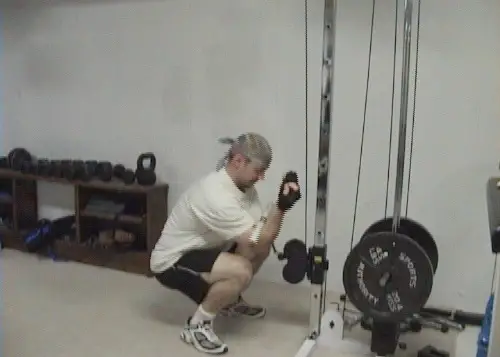
Now get yourself set in the bottom of the squat, with your arms bent.
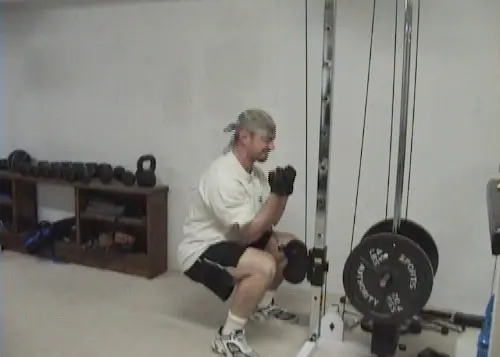
Then stand up! You'll notice that I'm leaning back a bit as I come up to counter the forward pulling of the pulley.
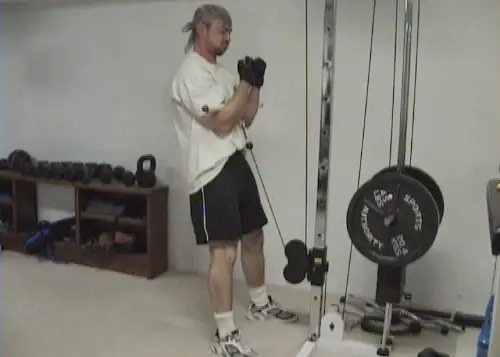
Repeat.
If you've never done Zercher Squats before, this is an easy way to give it a try and really feel the benefits of this underused exercise.
Another excellent core support strength exercise is the Barbell Curl Squat.
More From Fitstep.com
| The 7 Biggest Training Mistakes I've Ever Made | |
| Incinerate Fat With Near-Maximal Interval Training | |
| Exercise At Home With Improvised Equipment | |
| Flatten Your Pooch Belly With This Easy Exercise |
How To Do Cable Crunches:
Stand or kneel in front of a high pulley and grip a bar with an underhand grip or use a rope. The bar should be held to the back of your head so your wrists are close to your ears.

Lean over slightly with a bit of an arch in your lower back. This will hit a greater range of motion.
Crunch your elbows downward, pivoting at approximately the bottom of the ribcage, not the waist.

Your waist should not move much (waist movement indicates hip flexor involvement). Squeeze hard then rise up until your back is arched again.
At the top, imagine you have someone putting a forearm across the small of your back and you must wrap yourself around it.
Tricks for Performing Cable Crunches:
1. Tighter squeeze
To get a tighter squeeze, crunch down until your head is almost between your legs. This is best done kneeling on the end of a flat bench placed in front of the pulley. Crunch down and in towards the bench until your head is below the level of the bench.
2. Suck in your gut
Suck in your gut before and during the crunch to target the extreme upper abs. The sucking in of the gut decreases the leverage of the rest of the rectus abdominis. To target the obliques, you can come across to each side while keeping your gut sucked in.
3. Hitting the obliques
Another way to hit the obliques is to face the stack but crunch down on one side at a time, i.e. pull more on the left side of the bar and crunch over to the left slightly.
- This is a very subtle movement that requires and will develop excellent muscle control.
- Suck in your gut so that the rectus abdominis has poor leverage and the obliques do most of the work (you don't need to suck in your gut if you have sufficient muscle control to relax your middle abs while doing side crunches - the gut sucking will help develop this mind-muscle connection).
- Squeeze hard then do the other side.
Common Errors in the Cable Crunch Exercise:
1. Going too fast
Pumping the weight up and down will not create tension in the abs and can lead to injury when you reverse direction at the top of the movement. The lower back will take the brunt of that stress.
2. Using too much or too little weight
Use too little weight and you won't get anything out of it; you may even fall over. Use too much weight and you will have to use momentum to get the weight moving and will be straining your lower back rather than working your abs.
3. Not holding the contraction
The best part of this exercise is the contraction. Squeeze as much as you can out of the contraction at the bottom.
4. Bending at the hips not at the upper abs
Bending at the hips will work your hip flexors. Strive to bend at the upper abdomen in order to work the abs.
I would also recommend Abdominal Sit-Ups for strongly working the six-pack abs.
More From Fitstep.com
| 10 Vince Gironda-Inspired Training Tips | |
| High/Low Lactic Acid Training for Fat-Loss AND Strength | |
| 8 Easy Exercises You Can Do At Home | |
| Get a Ripped Six-Pack With Abdominal Sit-Ups |
Site Search

Subscribe to my YouTube Channel
And see every new exercise and training technique when it's released!
Recommended For You...
Time-Volume Training
Build muscle and strength like clockwork, even with very limited equipment, or NO equipment at all. This unconventional approach even builds muscle with light weight, saving your joints and nervous system from overload while you build mass fast.
Build muscle like clockwork now...