Wide
Grip Front Pulldowns
| |
|
|
| |
| Primary
Muscles Worked: |
Description: |
| Latissimus
Dorsi (Lats) |
The
largest muscles of the back. |
| |
|
| Secondary
Muscles Worked: |
Description: |
| Rhomboids,
Teres Major, Trapezius |
Upper
back muscles that move the arm backwards. |
| Biceps
Brachii |
Flexing
muscles of the upper arm. |
|

|
|
|
|
|
|
| |
|
|
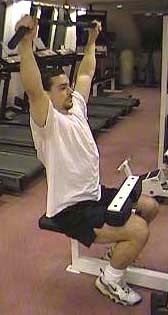
The Wide
Grip Pulldown is one of the most widely
known back exercises though few people actually do it properly. The mechanics
of the movement are very similar to the Close Grip
Pulldown, with the only major difference being the wider, overhand
grip.

|
|
- Take a wide grip
with your palms facing forward.
- Don't grip excessively
wide, though. About 4 to 6 inches outside shoulder width is fine (too
close will involve the biceps too much while too wide will reduce the
amount of weight you are able to use).
- Start with your
torso vertical and your arms overhead.
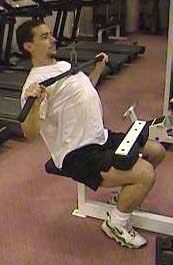
- As you begin to
pull down, lean back slightly, arching your lower back and puffing your
chest out to meet the bar. This isolates the lats better.
|
|
- Pull the bar down
to your mid-pecs, concentrating on pulling with your back muscles rather
than pulling with the biceps.
- When you get to
the bottom of the movement, try to squeeze your shoulder blades behind
your back for a second then slowly let the bar go back up.
|

| 1.
Drop the shoulder girdle |
This movement
should be done as a two-part movement to work your back best. Try this little
exercise to get a feel for the movement:
- Start by sitting in the
pulldown machine grasping the bar with your arms fully extended overhead.
- Allow your shoulders
to shrug up, letting the weight stretch your shoulders.
- Now try dropping your
shoulder girdle. This is the opposite movement of when you shrug your shoulders;
it is the down part. The arms should not bend in this part of the movement.
Your shoulders should just drop down a few inches.
- Practice this short movement
a few times.
- Once you have the feel
for that, add this to the pulldown movement by first shrugging down, then
pulling the bar down the rest of the way.
- You should feel a difference
in your back immediately as this technique will lock your lats into activation.
- Repeat this technique
at the start of every rep.
| 2.
Keep some bend in the elbows |
Do not let
the elbows go completely straight at the top of the movement. Keep some bend
in the elbows and some tension in the biceps. This allows the stretch to occur
in the back where you want it rather than in the arms and shoulders.
| 3.
Using a thumbless grip |
Try using a
thumbless grip to decrease biceps involvement.
- Instead of wrapping
your thumbs around the bar, place the fingerprints of your thumbs on the underside
of the bar as though making a "thumbs up".
- As you pull down, push
with your thumbs against the bar.
- This pushing will activate
the triceps slightly and reduce biceps activation.

The errors
include those mentioned with Close
Grip Pulldowns. Some specific ones for this exercise include:
|
|
|
|
| 1.
Pulling down behind the neck |
This is also known
as the Behind-the-Neck Pulldown
exercise.
- It is not a good
exercise and can lead to shoulder problems in the long term.
- The position of
the arms in the shoulder sockets is a sensitive one.
- Even with enough
flexibility to do the exercise properly (which few people have) there
is still a large risk of injury.
- The shoulders are
just not designed to work with resistance in that position.
|
|
| 2.
Taking
too wide or too narrow a grip |
If you
find your biceps are more fatigued than your back, your grip is too narrow.
- If you have a
very small range of motion, your grip is probably too wide.
- The grip you should
be taking is at or near the point where the bar starts to bend down.
- The longer your
arms are, the further down the bent part you can safely grip.
- The shorter your
arms are, the closer in your hands will need to grip.
|


Copyright 2001 BetterU, Inc.
©