Close
Grip Pulldowns
| |
|
|
| |
| Primary
Muscles Worked: |
Description: |
| Latissimus
Dorsi (Lats) |
The
largest muscles of the back. |
| |
|
| Secondary
Muscles Worked: |
Description: |
| Rhomboids,
Teres Major, Trapezius |
Upper
back muscles that move the arm backwards. |
| Biceps
Brachii |
Flexing
muscles of the upper arm. |
|

|
|
|
|
|
|
| |
|
|
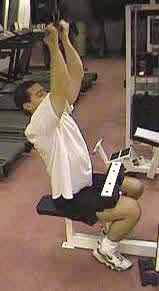
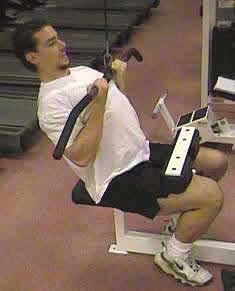
The Close
Grip Pulldown is very similar in appearance to the Chin-Up.
The pulldown machine allows you to use weights that are less than your bodyweight,
which is useful for higher repetitions. It also allows you to use much more
than your bodyweight making it very useful for advanced trainers.

|
|
|
|
- Sit in the pulldown
machine with your hips right up under the pads (they are hip pads, not
knee pads).
- Take a slightly
less than shoulder-width, underhand grip (palms facing you) on the bar
or use a V-bar.
- Start with the
body vertical, arms straight over your head.
- Begin the movement
by arching your lower back slightly and sticking your chest out.
|
|
- Pull the bar down
to your lower pecs, leaning slightly and smoothly backwards as you pull
to hit all the fibers in the lats. The lat is a fan-shaped muscle and
the lean back spreads the load over the whole fan.
- Puff your chest
up to meet the bar and try to squeeze your shoulder blades together
behind your back.
- Let the bar up
slowly then repeat.
|

This movement
should be done as a two-part movement to work your back best. Try this little
exercise to get a feel for the movement:
- Start by sitting in the
pulldown machine grasping the bar with your arms fully extended overhead.
- Allow your shoulders
to shrug up, letting the weight stretch your shoulders.
- Now try dropping your
shoulder girdle. This is the opposite movement of when you shrug your shoulders;
it is the down part. The arms should not bend in this part of the movement.
Your shoulders should just drop down a few inches.
- Practice this short movement
a few times.
- Once you have the feel
for that, add this to the pulldown movement by first shrugging down, then
pulling the bar down the rest of the way.
- You should feel a difference
in your back immediately as this technique will lock your lats into activation.
- Repeat this technique
at the start of every rep.
A good way
to get the feel for the proper technique at the bottom of the movement is to
have somebody put his or her knee in your mid-back on your spinal column.
- This will force you to
wrap your back around it, arching the back and puffing out the chest.
- Focus on trying to squeeze
the knee with the shoulder blades to feel the movement.
It is a little
known but important trick that you should breathe backwards when doing pulldowns
and chins (especially pulldowns). Here is the sequence.
- At the top, inhale deeply,
hold it and pull down.
- Exhale as you let the
bar up.
- The reason for this is
that the chest should be puffed up when you are pulling down to maximize tension
on the lats.
- When you exhale, you
collapse your chest, caving it in and increasing the work on the biceps. This
is the opposite of what you want to do.
- By holding a deep breath,
you puff the chest more and arch your back more, greatly increasing the effect
of the exercise.
To keep tension
on your lats and remove the biceps from the exercise, don't let your elbows
straighten as you come to the top of the movement.
- Keep a constant bend
of about 20 to 30 degrees at the elbow.
- Feel the stretch in the
lats when you let your shoulder girdle rise up without straightening your
elbows.
- Keeping the elbows bent
decreases the leverage and therefore the force the biceps are able to contribute
to the movement.
When doing
pulldowns with a thumbless grip, try placing the thumb so that the thump-print
area is pushing on the underside of the bar. This will help take the biceps
out of the movement.
Do scapular
rotations at the end of a set to extend it.
- This is done by dropping
your shoulder girdle (like shrugging downward) without bending the arms.
- This is a good way to
finish off the lats when the biceps are fatigued and unable to continue with
the pulldown movement..
- This can also be used
to pre-exhaust the lats by starting with scapular rotations.
| 7.
Using heavier than bodyweight |
If you are
using a weight that is heavier than your body then you have several choices:
extend the chain down until the handle is at a point where you can reach it,
hold the handle then have someone push you down (on the shoulders), or hang
on then jump up in the air then dive bomb down into the seat and under the pads
(this momentum will increase your bodyweight momentarily and allow you get into
position - it looks like you're taking a run at it.

| 1.
Jerking the weight with the lower back |
This error
is often made by people who are using too much weight in an effort to use momentum
to get the weight moving. This reduces the effectiveness of the exercise by
taking tension off the target muscles. It also can potentially damage your lower
back.
| 2.
Pulling down in a vertical body position |
If your
torso is vertical when you do a close-grip pulldown, your biceps will
take up much of the work, limiting the work your back muscles get. It
is important to lean back slightly, puff your chest out and arch your
lower back slightly. Be sure not to arch excessively, though.
| 3.
Using too much or not enough weight
|
You are
using too much weight if you must use your lower back to start the weight
moving, you lean back excessively, and/or you jerk the weight.
- Not using enough
weight can be just as bad as using too much weight.
- Not using enough
weight will not allow you to lean back sufficiently to use proper form
as there is nothing to exert tension on to keep your torso from falling
over backwards.
- If you can pull
the bar down to your hips or if you find you must keep your torso vertical
or you fall over, you are probably not using enough weight.
|
|
|
|
This reduces the
effectiveness of the exercise by decreasing the tension on the lats. Leaning
too far back is often a symptom of using momentum from your lower back
to pull the bar down.
| 5.
Jerking the shoulders at the top |
This error is caused
by not controlling the weight on the way up. The weight must then be stopped
by the shoulder joints. This can lead to shoulder injury. Going too fast
on the way up also reduces the amount of tension on the muscles. Remember,
control the weight at all times.
|


Copyright 2001 BetterU, Inc.
©