
If you're training at home with very little equipment, this workout is EXACTLY what you've been looking for...
All you need for this one is your bodyweight, a bench or chair, and something to do a pulling exercise on (either a chin-up or inverted row). It's going to cover every single major muscle group in your entire body in just 3 exercises, done in a very specific pattern.
The first time I performed this workout, I was blown away at how effective it was.
What Is Time-Volume Training?
Time-Volume Training is a system that uses training volume instead of intensity to build muscle and strength (and burn fat!). This basically means you get results by doing a lot of "easier" work instead of less "harder" work.
TVT is perfect for training at home with bodyweight, light weight or limited equipment.
To perform the "base" version of Time-Volume Training, you would select a weight you can get 10 reps with and then perform sets of 3 reps, with 10 seconds rest in between sets. Then you just keep repeating those 3-rep sets until you can't get 3 good reps. Then you increase the rest to 20 seconds.
Instead of adjusting weights or reps, you're adjusting REST.
This method of training has a TON of benefits, that you can read more about here.
The 5-3-1 Bodyweight Time-Volume Workout
This workout takes the base concept of Time-Volume Training and changes the rep ranges based on the challenge of the exercise you're doing.
The 5-3-1- refers to the number of reps you're going to be doing on three different exercises (not the strength program of a similar name created by Jim Wendler)...one push, one pull and one leg exercise. You'll do 5 reps of a push exercise, then immediately go to 3 reps of a pull exercise, then 1 rep of a leg exercise.
The key with this workout is exercise variation selection.
You want to choose appropriate exercises for each movement type so that the challenge is approximately equal on all of them.
You'll start off by taking no rest at all, moving directly from one exercise to the next. Once you approach failure on one of the exercises, you'll then start to take 10 seconds rest in between each exercise...then 20 seconds, etc. if needed.
You'll do this for a set block of time, such 10, 15, 20 or 30+ minutes. I recommend using this for a relatively longer block of time (e.g. 30 minutes) and using it as a total-body workout.
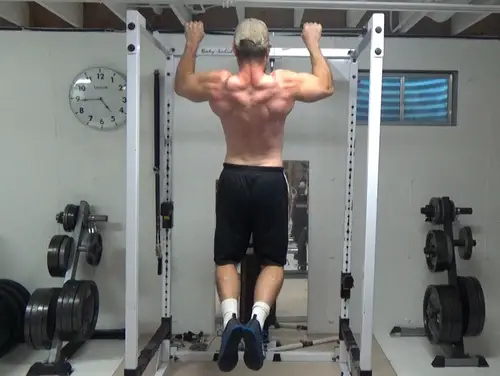
In the demo, I'm using a Bench Clench Push-Up, a neutral grip chin-up, and an elevated pistol (single leg squat).
Here's the video demo...pictures and rundown below...
Exercise #1 - The Bench Clench Push-Up
You can do ANY push exercise you like here in place of this one (even a free weight exercise), if you don't want to do this one. This push exercise should be one you could normally get about 15-20 reps with.
Personally, I LOVE this variation of the push-up for activating the chest. It gives you a much better contraction and will really light up your pecs.
To do this push-up variation, you'll need a bench or a chair...basically something about 12-18 inches wide that you can set your hands on the edges of, instead of on top of.
The idea here is to push INWARDS against the chair or bench instead of up, like you would in a regular push-up. This dramatically ramps up the tension being applied to the pecs.
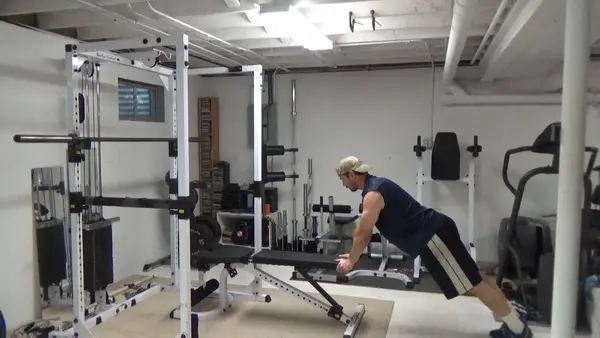
Come down to the bottom, lower until your chest touches the surface, then push inwards to move upwards. Repeat for 5 reps.
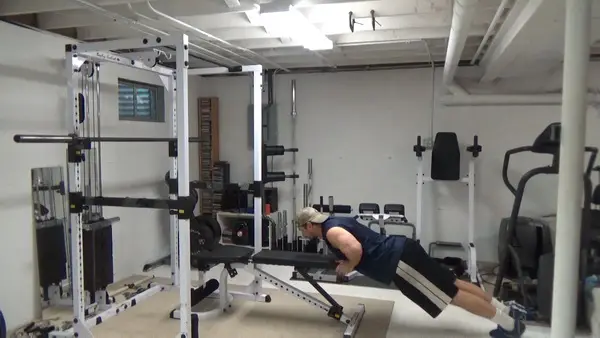

With any push exercise you do here, make sure you're using tight form and really focusing on muscle contraction on every rep.
Exercise #2 - Neutral Grip Chin-Ups
This can be any version of chin-up, pull-up or inverted row. I'm using a pair of C Clamps from the hardware store, attached to a rafter of my basement ceiling. This works GREAT for chin-ups...just make sure you clamp them down hard. The just grab on and perform as normal.
If you want to do inverted rows, you can often do these by lying underneath a table and gripping onto the edge, then pulling yourself up into a bodyweight row (just make sure the table is solid enough that it won't tip over).
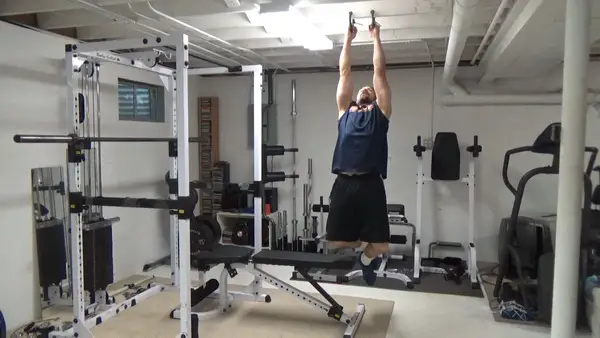
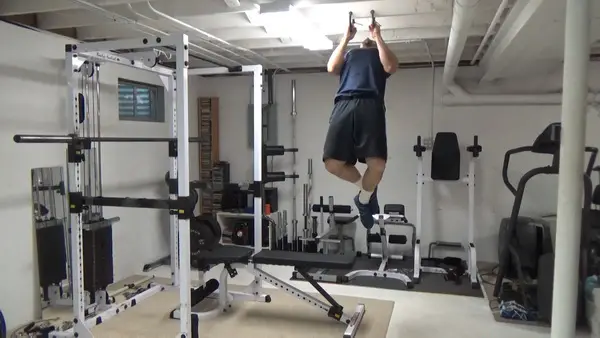
This pull exercise should be one you could normally get about 10-15 reps with. Since the rep range is going to be lower than the push exercise (3 reps instead of 5 reps), the idea is to use an exercise that is a bit more challenging.
Exercise #3 - Elevated Pistols
Again, you can use any variation of leg exercise for this, that is appropriate to the challenge level we're looking for here (something you could normally get about 5-7 reps with).
The exercise I'm using is something I call an Elevated Pistol...it's a single-leg squat, done standing on a bench or chair. Hold onto something solid beside and a little in front of you for balance and for assistance, as needed.
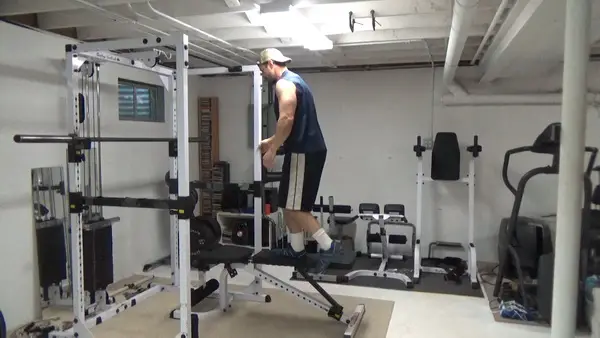
Come down into the bottom position, similar to a pistol. In this case, because you're elevated and stabilized, your front leg position or balance won't be limiting factors in the exercise. You can focus on coming down fully into the bottom position, then using leg power to push back up.
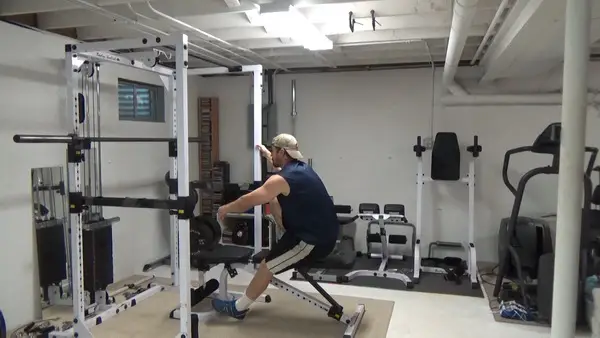
Do the one rep with this then turn around and do a rep with the other leg.
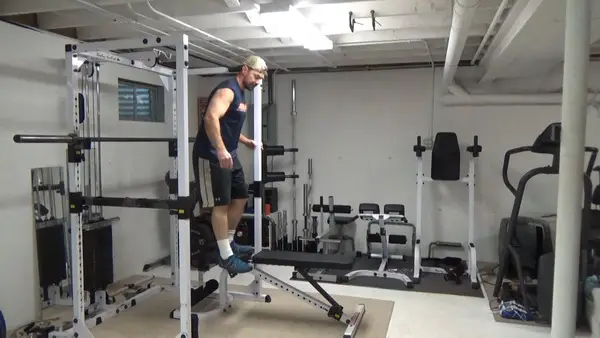
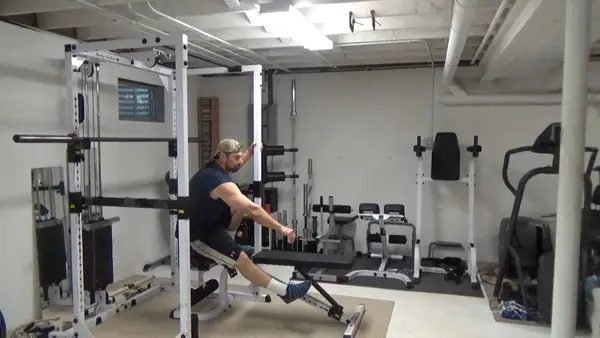
You can use any leg exercise for this one...if you're fairly strong in your legs, a single leg squat variation will be your best bet. Again, because you're doing single reps, this exercise should be more challenging than the push or pull exercises...something you could get about 5-7 reps with.
Performing the Full Workout
You're going to cycle through these three exercises non-stop for your designated block of time.
I used a 30 minute block in the demo workout and I was able to continue with no rest until about 17 minutes in. Then I went to 10 seconds rest between each exercise for the remainder of the time.
This is a killer workout...you're doing a lot of volume but not a lot of reps in each set, so you're still focusing on the fast-twitch muscle fibers. It's also going to demand a lot of your cardiovascular system, due to the continuous work being done by the biggest muscles in your body.
It won't feel very hard at first...don't let that fool you. As fatigue builds up in your muscles, it's going to get TOUGH...and you will get WORKED.