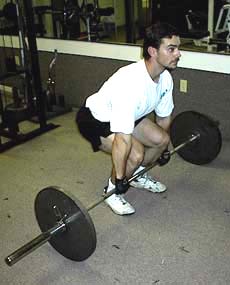
Deadlifts
| |
|
|
| |
| Primary
Muscles Worked: |
Description: |
| Erector
Spinae |
The
muscles that move and support the spine. |
| Quadriceps |
Frontal
thighs muscles that extend the knee. |
| Gluteus
Maximus |
The
largest muscle of the rear end. |
| Secondary
Muscles Worked: |
Description: |
| Hamstrings |
The
muscles on the back of the thighs. |
| Latissimus
Dorsi, Trapezius |
Muscles
of the back and neck. |
| Calves |
The
lower leg muscles. |
|

|
|
|
|
|
|
| |
|
|
The Deadlift
is a powerful but rarely utilized exercise that should be a part of every serious
trainers routine. It uses more active muscle mass than any other exercise, including
squats. The focus of the Deadlift, however, is the back. The Deadlift
is extremely useful for building muscle mass and total body strength because
of the great amount of muscle mass it uses.

|
|
|
- Step up to a loaded
barbell. Place your feet slightly less than shoulder-width apart and
crouch down with the bar touching your shins.
- Grasp the bar with
either a palms-down grip or a mixed grip (one hand palm-up, the other
palm down) just outside your legs.
- At this point,
your legs should be bent at 90 degrees or less, your back should be
straight (do not hunch over), your head should be vertical and your
eyes should be looking straight or slightly up.
|
|
- Begin the movement
by straightening your legs (standing up).
- As the bar clears
your knees, straighten your back until you are standing vertical with
the weight.
- You should essentially
be dragging the bar up your shins and legs in order to keep the weight
as close to your body as possible.
- This minimizes
torque on your lower back.
- Lower the weight
slowly and repeat.
|
Here are a few tips to remember
as you are deadlifting.
- Squeeze the bar off the
floor - don't snatch at it.
- Keep looking straight
forward as you lift. It is not necessary to look way up nor is it a good idea
to look down.
- Consciously lead with
your head and shoulders to maintain a flat back.
- Keep off your toes.

Just before
you start to lift the barbell, let your center of gravity fall backwards as
though you were going to fall over backwards.
- As you fall backwards,
start to lift.
- The momentum of your
mass moving backwards will help get the weight started.
- Sit your butt down as
far as you can as you are doing this.
Using a power
rack, set the pins so that they are just above knee level. Do partial deadlift
lockouts to improve lockout power or just to use more weight, which can also
help work on your grip.
|
The mixed grip (one
hand facing forward, one hand facing back) is better for a stronger grip
as it prevents the bar from rolling.
- Alternate which
hand grips which way to prevent strength and muscle imbalances.
- Be sure you grip
evenly if you do use a mixed grip.
- If you find the
weight swinging to one side excessively, adjust your grip spacing accordingly.
- The side it is
rotating to is usually closer to the center of the bar though this could
also depend on which way you are gripping.
- The bar usually
has a tendency to rotate towards the hand that has a pronated grip (palms
back).
|
|
Try doing deadlifts continuous
style.
- Do not allow the weight
to touch the floor in between reps.
- This is difficult but
is a very effective technique.
- It is also useful in
gyms that will throw you out for dropping weights heavily on the floor.
- The most stressful part
of the lift is when you reverse the direction of the barbell and lift it back
up again. This is also the most vulnerable position for your lower back. Use
perfect form for this technique.
| 5.
Increasing the range of motion |
In order to
improve power off the start, deadlift off a block. Another way is to train with
smaller plates, e.g. instead of always using 45's, use 35's or even 25's.
If you are
just starting out with the deadlift and need to use smaller plates, try setting
the bar in the rack or on the bench so you don't have to lean over excessively.
| 7.
Keeping the bar close to your shins |
If you have
trouble keeping the bar close to your shins, stretch out your calves thoroughly
as poor calf flexibility may cause this.
If you find
your grip slipping if you use a pronated grip and you don't wish to use an over-under
grip because of the torque on the body, try using two single cable handles.
- Slide them onto the bar
before you put the weight on.
- This will allow you to
use a neutral grip.
- Put padding under the
handles so they don't slide on the bar and make very sure they are even.
| 9.
Wear pants or long socks |
Wear pants
or pull your socks up so you don't scrape up your shins while lifting. It is
also a good idea to wear solid-soled shoes or boots while you are deadlifting.
This prevents your force off the ground from being dissipated in soft shoe soles.

| 1.
Allowing the back to round over |
Always
try to keep an arch in your lower back. It is natural for a little rounding
to occur after the bar has cleared your knees but if you do the entire
exercise with a rounded back, you are going to get hurt.
If one
side of the bar comes up higher or if the bar starts rotating as you are
lifting, then you are lifting unevenly. To remedy this, make sure your
grip is even on the bar. Using a mixed grip can cause rotation as you
lift so be sure to pull up evenly.
| 3.
Leaning back at the top |
Do not
lean back at the top of the movement. This could relax the erector spinae
and make the spine take the whole load, leading to injury. Leaning back
at the top does not constitute a full range of motion.
|
|
Don't hold
your breath during the movement as that can increase blood pressure to dangerous
levels.
Don't forget
the negative portion of this movement. Don't just drop the weight. Lower it
slowly. The negative is an extremely valuable part of the deadlift.

|
|
The feet
are placed wide (just inside the plates on either side) with the toes
pointing somewhat out.
- The grip is inside
shoulder-width (about 1 foot or less between hands).
- The execution is
the same as in conventional deadlifts.
- This style reduces
the amount of leaning over and is a good alternative if you just can't
seem to do conventional style properly due to biomechanical difficulties.
- Most people can
use more weight with this version due to the more upright posture.
|


Copyright 2001 BetterU, Inc.
©