Bent-Over
Rows
| |
|
|
| |
| Primary
Muscles Worked: |
Description: |
| Latissimus
Dorsi (Lats) |
The
largest muscles of the back. |
| |
|
| Secondary
Muscles Worked: |
Description: |
| Rhomboids,
Teres Major, Trapezius |
Upper
back muscles that move the arm backwards. |
| Biceps
Brachii |
Flexing
muscles of the upper arm. |
|

|
|
|
|
|
|
| |
|
|
The
Bent-Over Row builds thickness in the upper back and uses the lower
back and abs to stabilize the body during the movement. The biceps also contribute
to the movement, however care should be taken to minimize biceps involvement
as the biceps are the weakest muscle in the chain.

- There are several
variations but the most effective version for the lats is the reverse-grip
row.
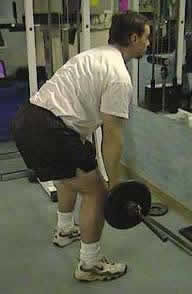
- Bend your knees
and bend over at the waist, keeping an arch in your lower back and looking
forward. It is important not to round your lower back in this exercise.
- Take a shoulder-width,
palms-up grip on the barbell. Your knees will be inside your arms during
the movement. The next thing you should do is suck up your abs and hold
them tightly in. This will stabilize your abdominal area.
|
|
|
|
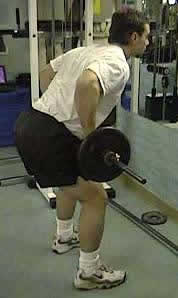
- Keeping your knees
bent (the angle will be somewhat greater than 90 degrees) and back arched
and without lifting with your lower back, pull the barbell back and
up into your lower abdomen.
- Fight the tendency
to stand up to help cheat the weight up, which can strain your lower
back.
- Also, do not dip
your upper body down to meet the bar. This will reduce the effectiveness
of the exercise and can lead to lower back injury.
- When done with
proper form, the bent-over row is one of the most effective back exercises
you can do.
|

| 1.
Coming in for a landing |
Imagine your body as a plane
coming in for a landing. This will help with your body positioning. Always look
forward when doing this exercise. Looking down will automatically cause your
back to round over.
If you have trouble keeping
in the correct position, do this exercise with your butt pressed against the
wall. By keeping it firmly in one spot, you will eliminate the tendency to stand
up.
Pause at the top of the
movement and squeeze your elbows in. This trick is hard to do with heavy weight,
though.
| 4.
Regarding weight belts |
Weight belts are not necessary
for this exercise if you are using proper form. Always keep your abs suck in
and tight and don't yank up with the lower back. Weight belts allow you to get
away with improper form.
Bent-over rows can also
be done with an E-Z bar. The wrist angle (halfway between palms-up and a neutral
palms-facing-in grip) of the cambered bar actually allows you to tuck your elbows
in to the sides better than a straight bar.
If you have a hard time
keeping proper body position, balancing the bar and pulling it up, try doing
this exercise on the Smith Machine. It will help stabilize your body by giving
you something to pull against. It is a very effective alternative and is a very
good way to introduce yourself to the movement.

| 1.
Improper body position |
This is most commonly
seen as the straight-legged, rounded back style. This is the worst position
for your lower back to be taking weight on. Always keep your lower back
arched, your knees bent, and your head up and butt down.
Always lift the weight
up using muscle power only. Yanking the weight up in this position can
cause lower back injury.
| 3.
Dipping
the upper body down
|
This is often done
as you pull the bar up in an effort to get the weight up to the end of
the rep. Instead of pulling the bar up to you, you are dropping yourself
down to meet the bar. This is a less effective way to train the back and
has the potential for injury. Keep your torso as steady as you can.
|
|
| 4.
Pulling
the bar up to wrong spot |
For maximum muscle contraction,
pull the bar up to your lower abdomen, not your upper abdomen. Pulling to the
upper abdomen will use the biceps and limit the amount of weight you can use
and the work done by the back.

This version will affect
the upper areas of the back (e.g. the upper lats, the teres major and the rhomboids).
- Take a palms-down, wider
than shoulder-width grip on the bar.
- Execute similar to reverse
grip but pull to higher on the ribcage, i.e. the lower pec line rather than
the upper abs.


Copyright 2001 BetterU, Inc.
©